Visualize Pure Math in Real-Time 3D
Render continuous mathematical zero-sets f(x, y, z) = 0 directly in your browser at 60 FPS. Featuring closed-form analytical polynomial solvers (degrees 1–6), dual-sided PBR materials, keyframe timeline animation, and watertight STL/OBJ export for 3D printing.
Real-time shader evaluation with dynamic resolution scaling
Exact closed-form roots with zero stepping artifacts
Direct slicer-ready 3D printing export via Marching Cubes
No Python, no Blender setup, no native binaries required
How SurfZar Works
From abstract algebraic equations to 60 FPS GPU pixels and physical 3D prints. Here is the mathematical pipeline powering SurfZar.
Implicit Algebraic Surfaces
Unlike traditional polygonal meshes that approximate curves with flat facets, implicit surfaces define geometry as the continuous zero-level set:
- Infinitely smooth: Zooming in never exposes polygon facets or edges.
- Analytical Normals: Computed directly from the gradient vector ∇f(x, y, z).
- Inside vs Outside: Natural spatial partitioning: f < 0 interior, f > 0 exterior.
Analytical Solvers & Raymarching
SurfZar evaluates ray-surface intersections using exact algebraic solvers whenever possible, falling back to iterative GPU raymarching for non-algebraic formulas:
- Zero Stepping Noise: Analytical solvers jump straight to the true root.
- True Singularities: Nodal points and self-intersections render crisply.
Marching Cubes & 3D Export
To bridge the digital-physical divide, SurfZar dynamically voxelizes the bounding domain into an N×N×N scalar grid and polygonizes the zero-crossing contour:
- Slicer-Ready STL: Watertight manifolds ready for Cura, PrusaSlicer & Bambu.
- Wavefront OBJ: Indexed vertices with smooth normals for Blender & Maya.
- Adjustable Resolution: Balance triangle count and generation speed.
Why Choose SurfZar?
Built for researchers, educators, and creative technologists who demand both mathematical rigor and real-time visual beauty.
Instant 60 FPS in Any Browser
Zero installation, zero native toolchains, zero Python or Blender setup. Experience high-performance WebGL & GPU raymarching on any device with instant load times.
Analytical Polynomial Solvers
Unlike standard raymarchers that step blindly through space, SurfZar detects polynomial degrees (1–6) and calculates exact mathematical roots using closed-form algebra.
Dual-Sided PBR Materials
Implicit surfaces inherently split 3D space into interior and exterior. SurfZar lets you assign completely distinct metallic, roughness, and color properties to Side A vs Side B.
Multi-Track Keyframe Timeline
Bring static mathematics to life. Animate parameters a, b, c, d alongside continuous time T. Place keyframes on multi-track channels with linear and bezier curve interpolation.
Compressed Base64 URL Sharing
Collaborate seamlessly. A single shareable link encodes your entire workspace: equation, camera coordinates, dynamic lights, material colors, and animation keyframes.
Watertight STL & 4K PNG Export
Export watertight manifold STL and Wavefront OBJ meshes directly into Cura or Bambu Studio for 3D printing. Render 4K anti-aliased PNG snapshots with transparency.
The Origins of SurfZar
SurfZar is based on iSurfer, a 2011 engineering thesis project developed by Daniel Azar at ITBA, inspired by the open-mathematics initiative IMAGINARY.
iSurfer at ITBA
Developed at ITBA (Instituto Tecnológico de Buenos Aires), Daniel Azar’s 2011 thesis pioneered real-time algebraic surface raymarching on mobile hardware: executing fragment shaders on the PowerVR GPU of the iPhone 3GS via raw OpenGL ES 2.0.
IMAGINARY & SURFER
iSurfer was directly inspired by IMAGINARY, the acclaimed open-mathematics initiative born at the Mathematisches Forschungsinstitut Oberwolfach. Their program SURFERshowed that algebraic surfaces could be experienced as interactive art.
SurfZar
SurfZar brings that mission to modern browsers: zero install, WebGL2 fragment raymarching, closed-form polynomial root solvers (degrees 1 through 6), interval arithmetic root isolation, keyframe animation timelines, and 3D print mesh export.
Who Is SurfZar For?
Whether you are deriving mathematical theorems, teaching university calculus, generating visual art, or slicing 3D prints, SurfZar gives you the right tools.
Mathematicians & Geometers
Rigorous Topological Exploration- •Inspect real singularities, double points, and cusps without stepping artifacts.
- •Explore Barth sextics, Cayley cubics, Kummer surfaces, and Steiner's Roman surface.
- •Verify algebraic degree classifications and gradient normal vectors in real-time.
University Educators & Lecturers
Interactive 3D Visual Proofs- •Demonstrate multivariable calculus, partial derivatives, and zero-sets live in lectures.
- •Share pre-configured camera angles and animated parameter variations with a single URL.
- •Engage students with intuitive, real-time spatial transformations.
STEM Students & Curious Learners
Build Geometric Intuition- •Turn abstract polynomial symbols into tangible, interactive 3D shapes.
- •Slide coefficients a, b, c, d to see immediate morphological transitions.
- •Learn the relationship between algebraic power degrees and geometric complexity.
3D Artists & Procedural Designers
Generative Mathematical Art- •Render mesmerizing surreal wallpapers and motion loops using triply periodic minimal surfaces.
- •Style surfaces with contrasting dual-sided metallic and dielectric PBR materials.
- •Capture 4K high-resolution PNG snapshots with transparent alpha channels.
Makers & 3D Printing Enthusiasts
From Equation to Physical Reality- •Polygonize implicit surfaces into clean, non-intersecting watertight STL meshes.
- •Directly import into Cura, PrusaSlicer, or Bambu Studio for FDM/SLA printing.
- •Print physical gyroid desk sculptures and complex architectural infill structures.
SurfZar in Action
Discover how educators, makers, artists, and researchers put implicit geometry to work.
Academic Teaching & Lectures
Live Multivariable Calculus DemosReplace static textbook diagrams with interactive 3D demonstrations. Animate partial derivatives, level sets, and parametric deformations live during university lectures.
3D Printing & Additive Manufacturing
Tangible Mathematical SculpturesConvert intricate mathematical topologies—such as gyroids, Schwarz surfaces, and algebraic cushions—into watertight STL meshes ready for slicing and physical manufacturing.
Wallpaper & Generative Art
Procedural 4K Visual ComputingHarness mathematical aesthetics to create stunning, high-resolution desktop wallpapers, motion loops, and procedural album art with dual-sided metallic PBR shaders.
Topology & Singularity Research
Exploring Nodal Points & Zero-SetsStudy algebraic singularities, Klein bottle immersions, and non-orientable surfaces. Exact closed-form polynomial solvers guarantee zero raymarching distortion.
Interactive Preset Showcase
Explore iconic surfaces from algebraic geometry, minimal surface theory, and theoretical physics. Click any card to open and edit live in the 3D studio.
Gyroid Minimal Surface
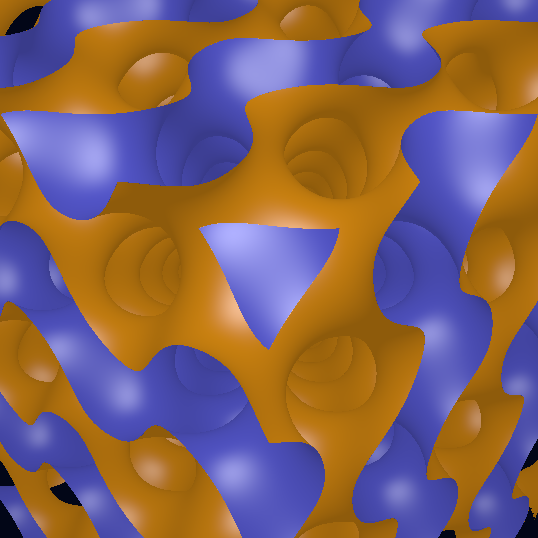
An infinitely connected triply periodic minimal surface (TPMS) discovered by Alan Schoen at NASA. Widely used in 3D printing for ultra-lightweight structural infill.
Steiner's Roman Surface
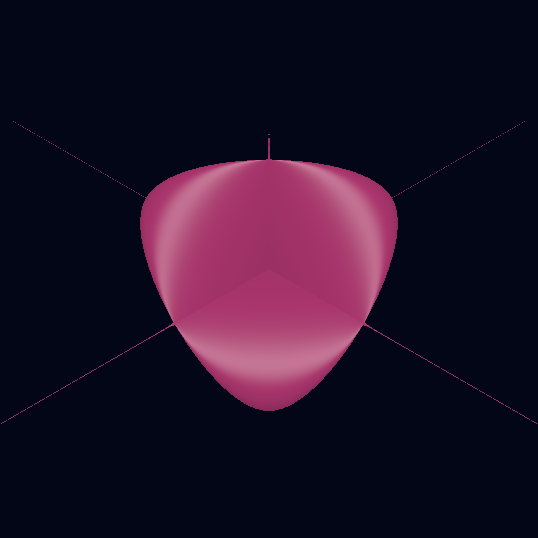
A self-intersecting mapping of the real projective plane into 3D space with tetrahedral symmetry and four pinch points.
Calabi-Yau 3D Cross-Section
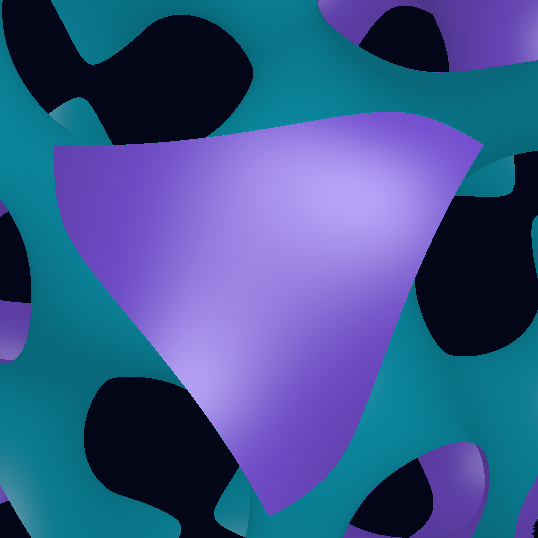
A 3D slice of a 6-dimensional Ricci-flat Kähler manifold fundamental to superstring theory compactifications.
Barth Sextic
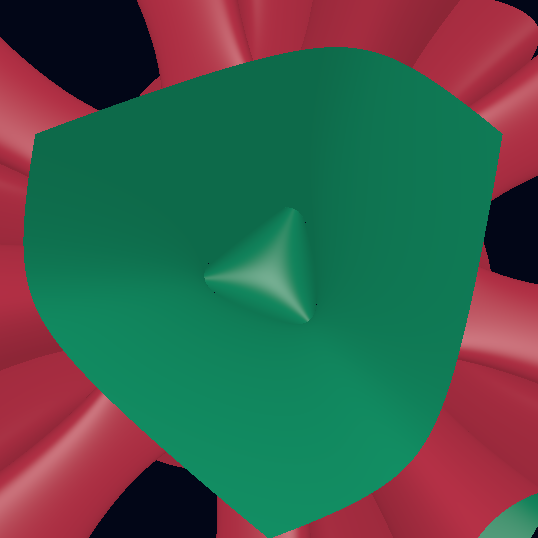
A degree 6 algebraic surface with icosahedral symmetry featuring 65 nodal double points, the theoretical maximum for a sextic.
Algebraic Torus
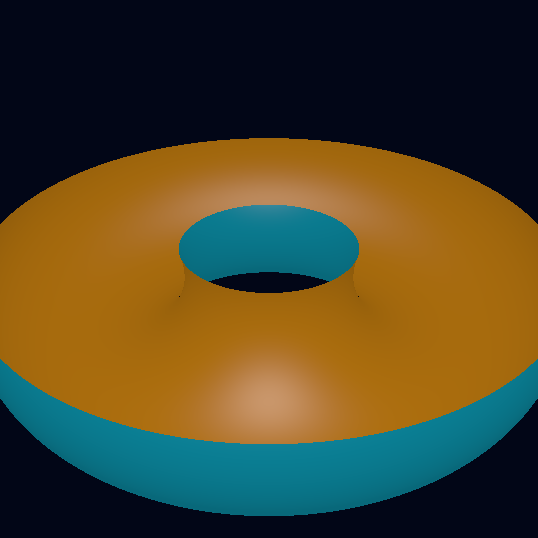
Closed-form algebraic formulation of the torus without square root radicals, solved exactly by Ferrari's quartic algorithm.
Cayley Cubic

The unique cubic surface possessing four ordinary double points. Evaluated with exact Cardano-Tartaglia closed-form roots.
Chmutov Decic
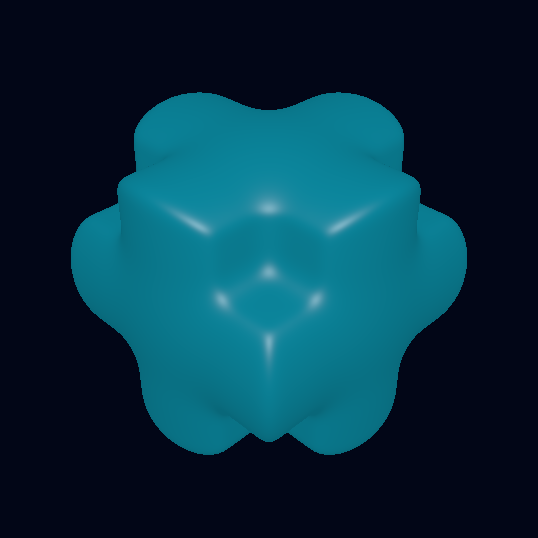
A high-degree algebraic surface constructed using Chebyshev polynomials to produce a dense lattice of nodal singularities.
Breathing Sphere
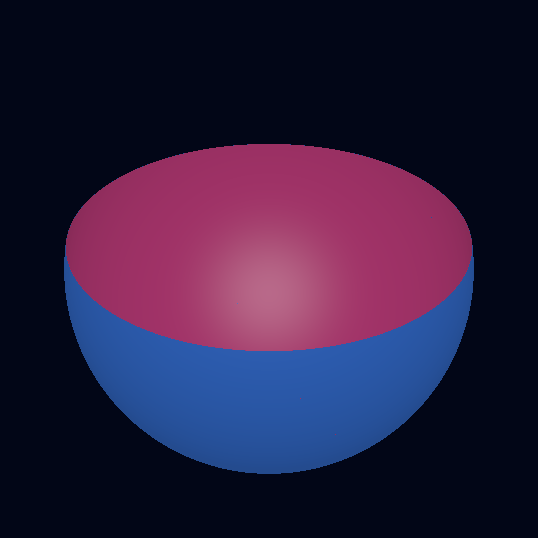
Dynamic surface utilizing the continuous timeline variable T to generate smooth cyclic pulsation without manual keyframing.
Waving Plane
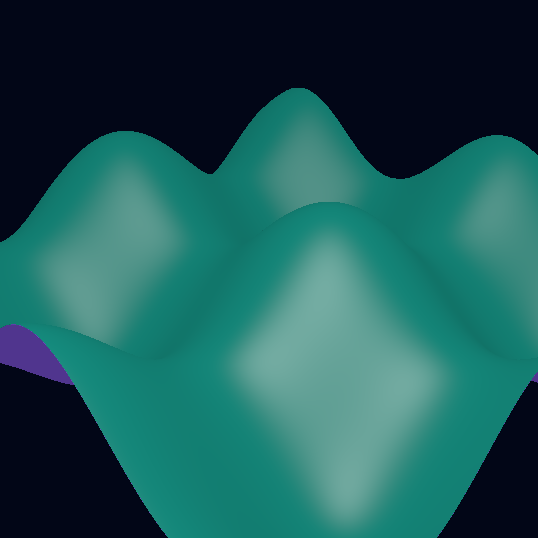
Interference topology controlled by four independent parameters a, b, c, d with keyframed animation tracks.
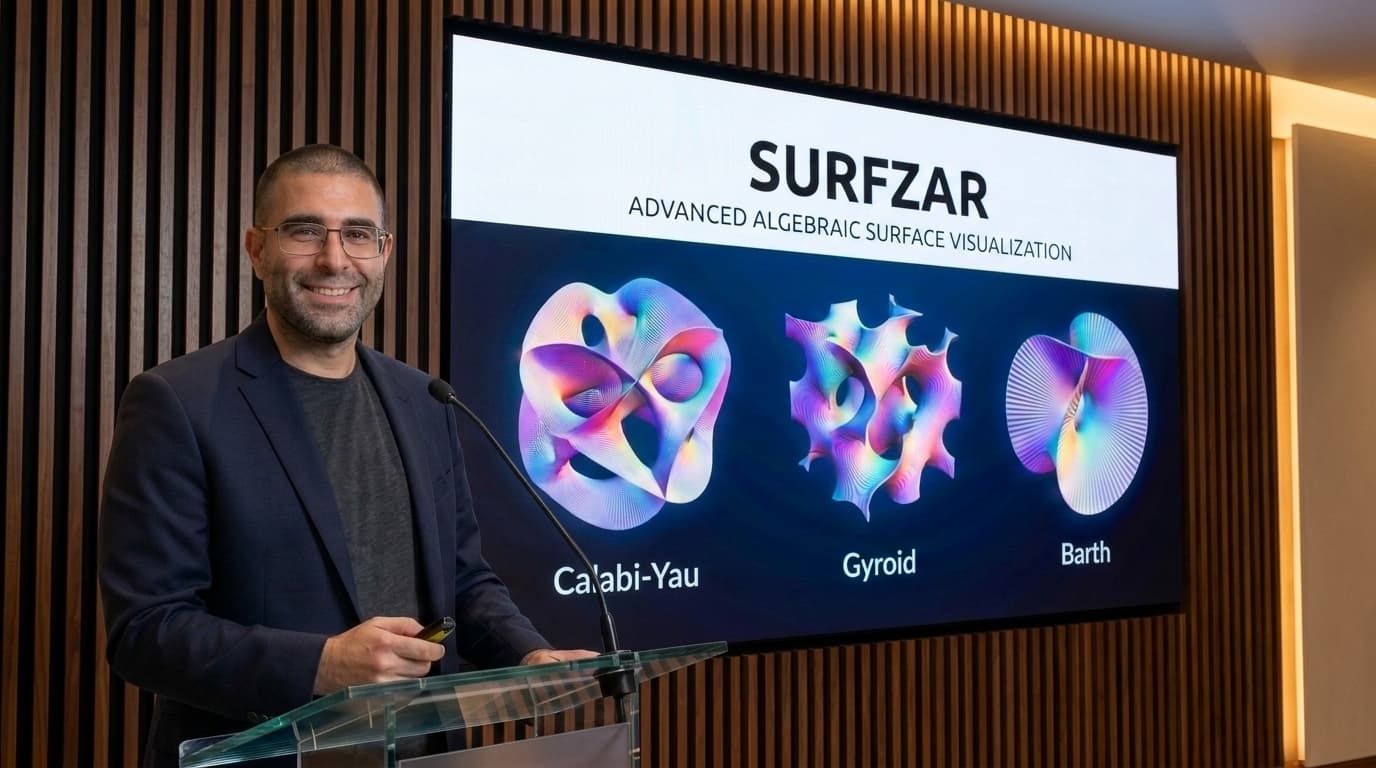
Made by Daniel Azar
Full-Stack Engineer • 3D Web Graphics & Mathematical Computing
SurfZar is the modern web evolution of Daniel’s 2011 university engineering thesis at ITBA (iSurfer), which pioneered real-time algebraic surface raymarching on the mobile GPU of the iPhone 3GS. Inspired by the open mathematics philosophy of the IMAGINARY institute, SurfZar carries that vision into modern browsers: combining closed-form polynomial root solvers, WebGL2 fragment raymarching, keyframe animation, and 3D printing into an interactive mathematical studio.